CONFINI
The project consists of two video installations that investigate the theme of borders and contemporary migration, exploring the human drama through data, testimonies, and a visual-audio rhythm.
Map of Losses
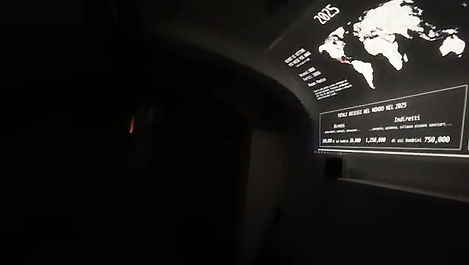
A map of the world gradually comes to life, indicating the places where, from 2014 to 2025, thousands of migrants lost their lives attempting to cross geographical and political borders: the Mediterranean, the border between Mexico and the United States, the Sahara Desert, the Bay of Bengal, and others. Each marked point is accompanied by a sheet providing the incident data: date, location, number of victims, origin, and destination. The installation builds a visual archive of the migratory tragedy, a geography of silence that grows over time. A minimal soundtrack acts as a visual metronome: it marks the passage of time and the progressive appearance of data on the map, accentuating the inexorable and repetitive nature of the news.

Overlapping Voices
In this second installation, the testimonies of surviving migrants appear on the screen in text form. Each sentence is repeated multiple times in random positions, forming visual blocks—abstract paintings composed of overlapping words. The result is a layering of memories that lose their individuality to merge into a collective presence, dense and visually powerful. The minimal sound does not accompany but structures: it punctuates the appearance and reiteration of the words, guiding the rhythm with which the painting forms and expands, like a mechanical breath or a regular heartbeat.


AUDIO ON/OFF
Data
The data used in the "Map of Losses" were extracted from:
"IOM's Missing Migrants Project" - https://missingmigrants.iom.int
(Please note that not all items are present in the "Map of Loses" installation)
Testimonies
The testimonies appearing in "Overlapping Voices" are from:
- Interviews conducted by the author as part of "Sabbia" social theater project (created by Riccardo Vannuccini - Artestudio), with asylum seekers at the Castelnuovo di Porto reception center (CARA)
- Interviews conducted aboard the Geo Barents (search and rescue vessel - Doctors Without Borders) - https://www.doctorswithoutborders.org/latest/stories-survival-mediterranean-migration-route
- Interviews conducted aboard the Life Support (search and rescue vessel - Emergency) - https://www.emergency.it/storie-migranti-dalla-life-support/
The author used MAX software (Cycling'74) to program the audio/visual processing of the data and testimonies


October 23-25, 2025, as part of the RAW - RomeArtWeek event at SuonousLab - Rome
December 28, 2025, at the "Stories of Guitars and Borders" event, at the Francesco Sandrelli Association - Camucia (AR)
WARS (2010 - 2026)
The work is a generative multimedia installation that transforms an archive of war data into a raw and inescapable sensorial experience. By mapping sixteen years of real conflicts—from 2010 to the most recent news of April 2026—the installation questions the viewer about the cyclical nature of violence, the market that fuels it, and the resulting human consequences.
The experience unfolds through a dual visual narrative: News and the economy: A relentless flow of data (year, location, direct/indirect deaths,
migration flows and arms flows) documenting global geopolitical reality. Flashes: A second screen entirely dedicated to color: the color saturation reacts in real time to sound intensity: from black (silence), to shades of red (varying levels of noise),
to the white of the most violent explosions.
The sonic chaos is constructed from a web of continuous electronic sounds combined with voices and explosions: the voices of politicians and their official statements are overwhelmed by the sound
of explosions and the noises of war.
Quantitative data on fatalities and the geolocation of clashes are derived from the ACLED (Armed Conflict Location & Event Data Project) databases.
Descriptions of individual incidents are drawn from contemporary newspaper reports and agency dispatches.
AUDIO ON/OFF


April 24, 2026, as part of the RAW for Peace festival
at SuonousLab
Via B. Franklin 3, Rome

URIHI A
a difficult balance
In the worldview of the Yanomami people, the forest (Urihi a) is not a mere geographical backdrop, an inanimate object, or a resource to be exploited. It is a living meta-organism, endowed with its own vital breath and inhabited by guardian spirits. There is no separation between human beings and the territory: the forest and humanity reflect one another.
URIHI A is a generative multimedia installation that investigates the boundary between the loss and persistence of life. The artwork combines historical data, real-time algorithmic flows, and an electronic soundscape that transforms the exhibition space into a vital ecological habitat.
The Structure of the Installation
The project unfolds across two simultaneous, continuous projections, accompanied by a generative soundscape.
Projection 1 — "The Extinct"
A screen dedicated entirely to the historical data of over a thousand animal species extinct from 1500 to the present day.
Essential strings of data appear randomly as points in space, slowly floating in the air and progressively growing larger until they fade away. Each string encapsulates the name, biological classification, geographical area, and year of the last sighting of the extinct species. From time to time, cards featuring statistics and data related to extinctions appear.
Projection 2 — "The Data"
A projection with a strongly informative and temporal character, structured as an ecological observatory.
Audio — "Soundscape"
The installation is completed through a generative electronic music score where the sounds evoke the calls and noises of impossible and ancestral creatures, giving life to a deep and distant soundscape.
The Sources:
-
IUCN Red List (The IUCN Red List of Threatened Species)
-
IPBES (Intergovernmental Science-Policy Platform on Biodiversity and Ecosystem Services)
-
Living Planet Index (WWF / Zoological Society of London)
-
Conservation and Research Organizations (WWF, Birdlife International, Conservation International, The Nature Conservancy, and others)
-
United Nations (UN DESA - World Population Prospects)
-
FAO (Fisheries and Aquaculture)


AUDIO ON/OFF
October 24 2026
As part of the RAW RomeArtWeek 2026 exhibition, hosted at SuonousLab in Rome
NO HELP
Interactive video installation

At the heart of this installation lies an investigation into the impossibility of receiving help — an emotional short-circuit where the very attempt to rescue or establish a connection shatters against an insurmountable barrier of silence and solitude.
The visitor enters a nearly dark room. On one side of the room is a door with a light above it that illuminates the space in front (a semicircle of light).
Behind the door, the sound of someone banging their fists can be heard, along with shouts (sometimes in multiple languages): "Let me out!", "Is anyone there?", "Help me!"The visitor approaches; the knocking and shouting are no longer heard, but a low, hesitant voice says, "Is there anyone back there...?"
The visitor arrives in front of the door: no more noises can be heard. The visitor opens the door (the light above the door goes out) and sees a person immersed in the darkness, watching them and fearfully retreating until they disappear into the darkness—beyond the door, everything is dark, and only the man walking away can be seen.
The visitor leaves the door, which automatically closes, and the light comes back on. When the visitor leaves and reaches a certain distance, the sounds of punching on the door and screaming begin again from the door.


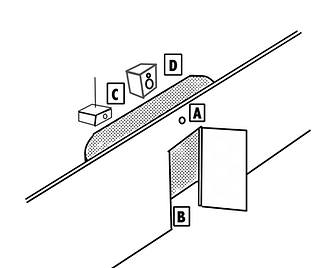
A - visitor detection camera
B - door opening sensor
C - projector
D - speaker